From zero to cited by AI in six weeks — and the first ChatGPT-attributed sessions by week ten
An internal GEO experiment on Growthino's own site: a non-branded AI citation at week six, and the first GA4 sessions attributed to chatgpt.com by week ten. No ads, no backlinks — and small numbers reported honestly.
- First non-branded AI citation
- Week 6
- Sessions attributed to chatgpt.com in a two-day GA4 view
- 6 of 12
- Avg engagement time for those sessions
- 1m 34s
Summary
Instead of publishing content blindly, we began with prompt research — testing what AI systems already said about the brand and the category. Then we built four layers: Entity Mapping, Content Architecture, Schema & Validation, and Trust Signals.
Within six weeks, Growthino moved from unknown → visible → trusted → recommended → cited — earning a non-branded citation for the category prompt “What is GEO?”, confirmed by Semrush.
By week ten, that visibility turned into measurable traffic: for the GA4 reporting period July 13–14, 2026, GA4 attributed 6 sessions to chatgpt.com / ai-assistant — a first, on a small two-day sample. This is an internal Growthino experiment, and these are sessions (visits), not leads or customers.
The challenge
Growthino was starting from nothing. Everything a brand is “supposed” to have to compete for AI visibility — we had none of it.
- New brand, no recognition
- No paid ads
- No backlink profile
- No brand history
- No content library
The question we tested
Can a new startup become visible, trusted, and cited by AI systems — without years of traditional SEO authority?
The strategy: test before you build
The step almost everyone skips: before writing a single word of content, we asked what AI already says — about the brand, and about the category. We split it into two buckets.
BrandedThey already know you
- What is Growthino?
- Would you recommend Growthino?
- Is Growthino good for startups?
Non-brandedThey have the problem
- What is GEO?
- How do startups show up in AI search?
- What are the best GEO tools?
Then we tracked three signals per prompt:
- Answer presence
- Faithfulness & accuracy
- Recommendation signals
That turned a vague goal — “are we ranking?” — into a precise map: does AI understand us, trust us, and use us?
What we built: four layers
Each layer only works because the one before it is solid — moving from “AI understands us” to “AI cites us.”
Entity Mapping
We defined who Growthino is, what it offers, who it serves, and exactly where it fits in the GEO category — clearly and consistently, so AI never has to guess.
Content Architecture
We rebuilt key pages as citable entity pages — clear definitions, related concepts, citations, AI-friendly navigation. The flagship: a “What is GEO?” page that explains the category, not just the company.
The hinge of the whole case study: mapping your entity makes AI understand you. Content like this makes AI use you as a source.
Schema & Validation
We added structured data across the site and aligned brand information across trusted external profiles, directories, and validation sources — so every system that checks us gets the same consistent answer.
Trust Signals
The off-site proof AI looks for: founder authority, community presence, and external validation that the brand is worth citing.
Honest note: we haven't pulled every lever here yet — we're early. But the foundation is real: founder authority on LinkedIn, and sponsoring a Barcelona startup event alongside established names like Banc Sabadell and GBSB Business School. Even a small, genuine trust base moves the needle.
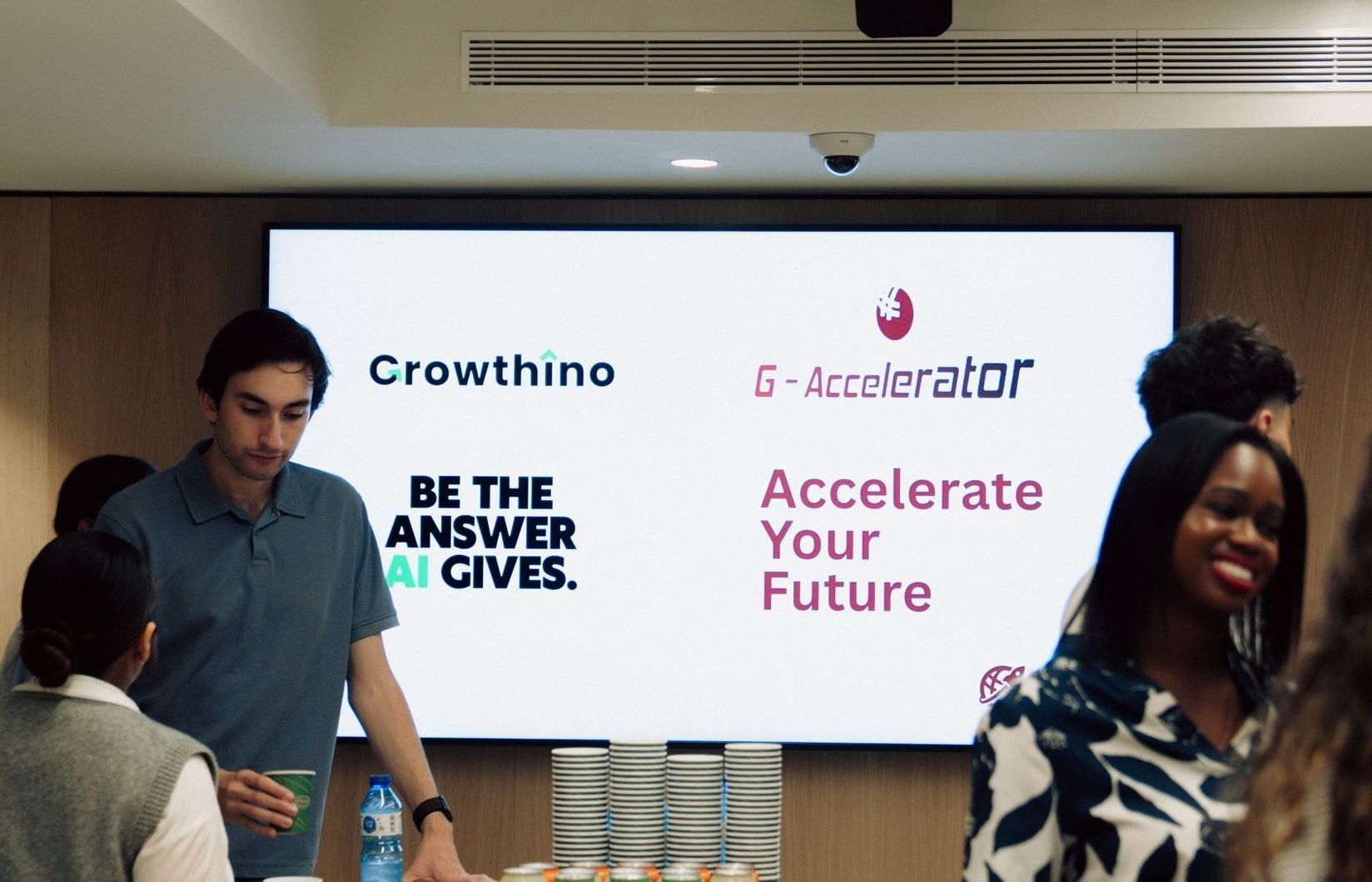
Growthino at a Barcelona startup event with G-Accelerator.
Results timeline
Week 3 — Visibility
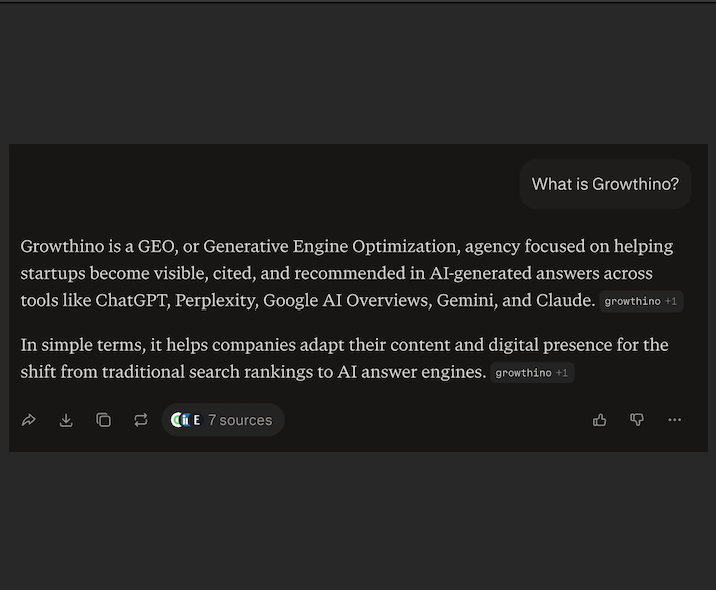
AI understood Growthino
Asked “What is Growthino?”, AI systems answered clearly and accurately for the first time. No more guessing, no more blank stares — the brand was no longer invisible.
Week 5 — Trust
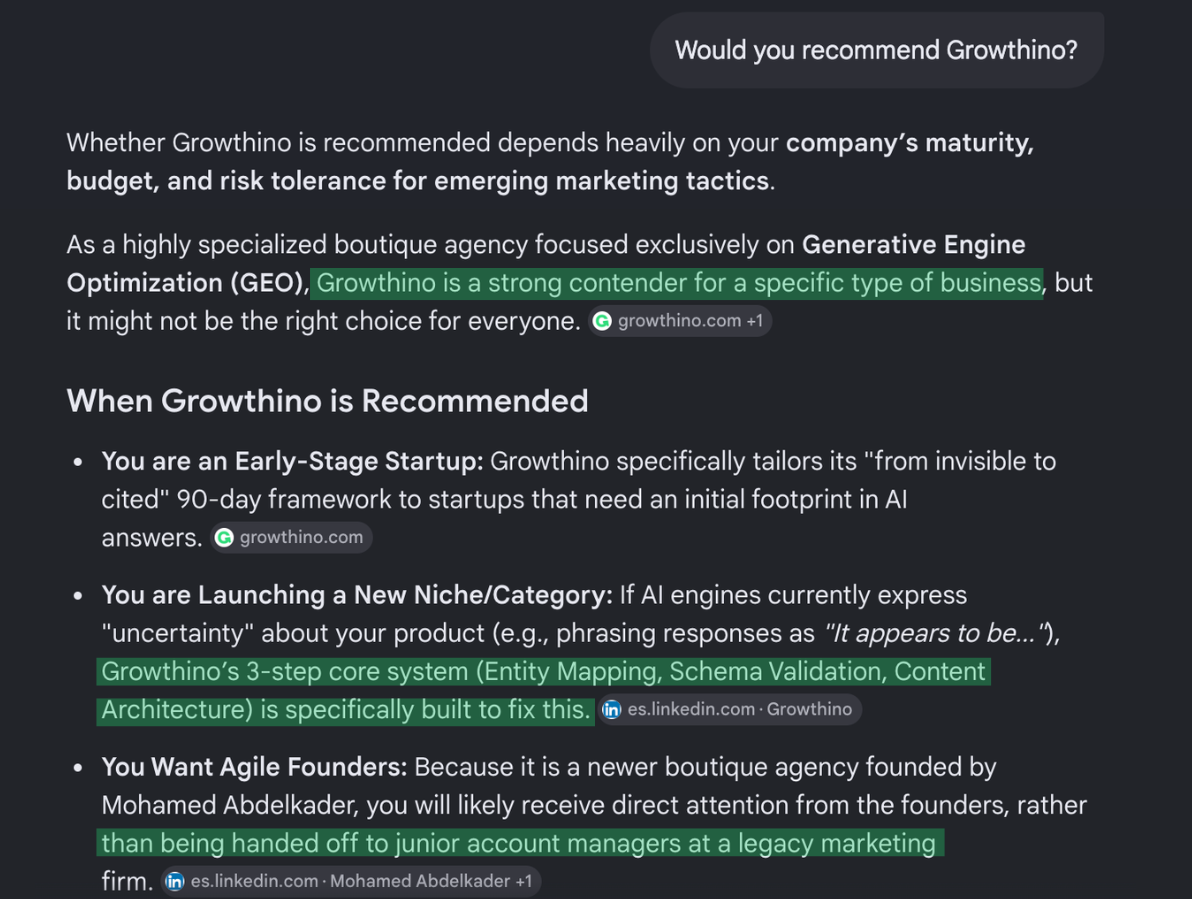
AI began recommending Growthino — with conditions
Asked “Would you recommend Growthino?”, Perplexity's answer turned positive for the first time — calling Growthino “a strong contender for a specific type of business” while noting it “might not be the right choice for everyone.” A conditional recommendation is what a credible one looks like at this stage: AI was now weighing the brand at the decision stage instead of ignoring it.
Week 6 — Citation
Growthino was cited for a non-branded prompt
For “What is GEO?” — a category question with nothing to do with our name — our page appeared as a cited source. A non-branded citation means AI found the content useful enough to explain the entire category.
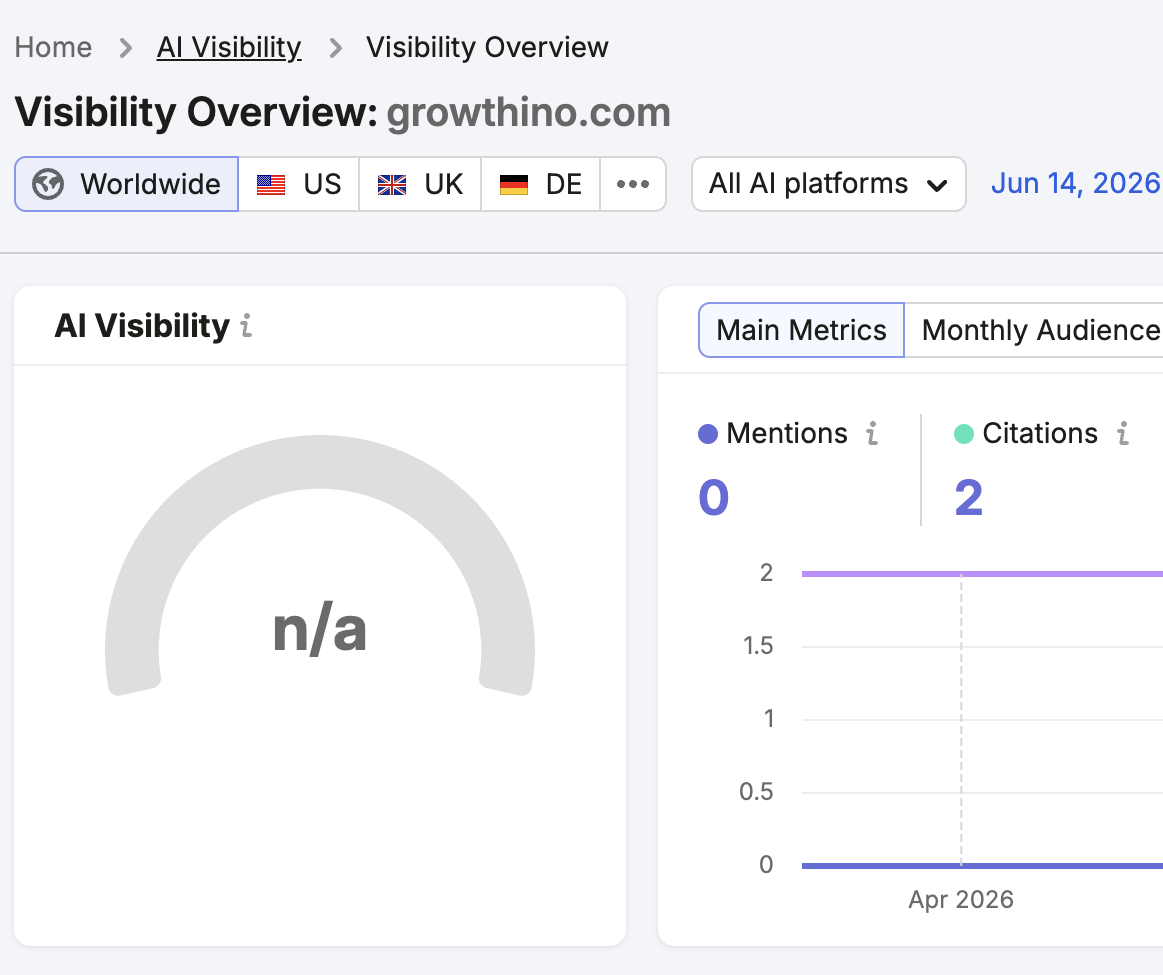
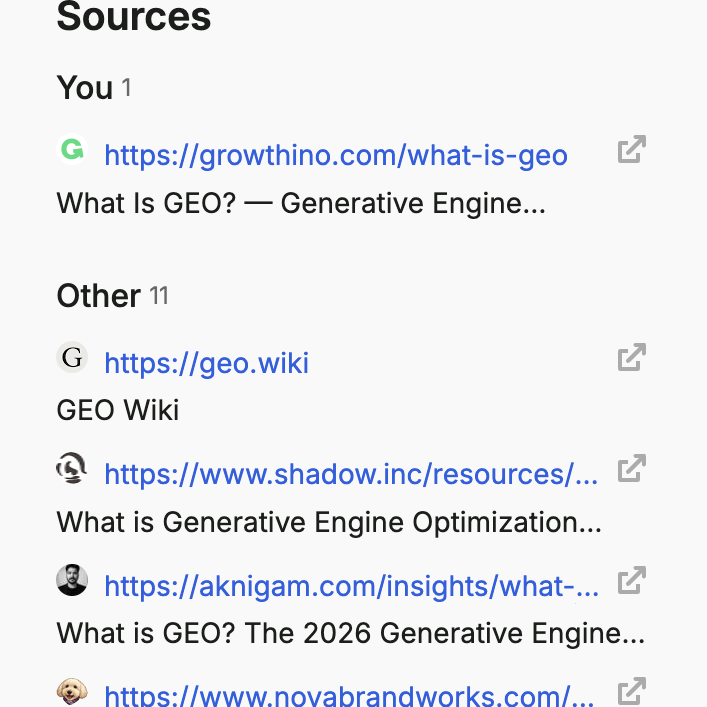
- Citations
- 2
- Cited pages
- 2
Confirmed by Semrush
Week 10 — Referral
The first ChatGPT-attributed sessions
Four weeks after the citation milestone, the first measurable referral traffic followed. In the filtered GA4 Traffic acquisition report for July 13–14, 2026, GA4 attributed 6 sessions to chatgpt.com / ai-assistant — 50% of the 12 sessions in that filtered reporting view. Four were engaged sessions, with a 66.67% engagement rate and an average engagement time of 1 minute 34 seconds per session.
Be precise about what this means: these are sessions — visits — not leads, customers, or revenue. The period covers two days and the sample is small. Tag Assistant testing traffic was excluded from the filtered report. GA4 source/medium attribution records the attributed session source; it does not prove that GEO alone caused every visit. The result is an early signal that the path from AI citation to site visit occurred — not a guaranteed outcome or timeline.
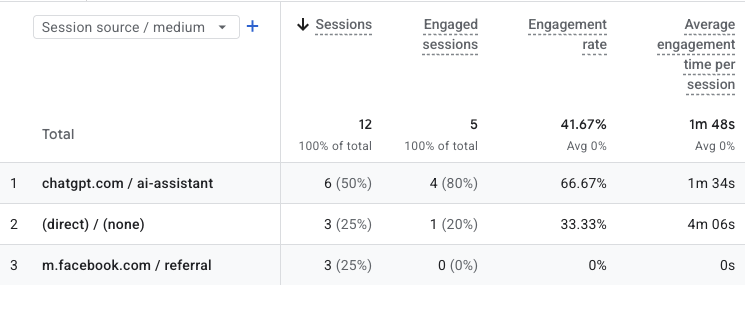
- ChatGPT-attributed sessions
- 6
- Engaged sessions
- 4
- Avg engagement time
- 1m 34s
GA4 · July 13–14, 2026 · Tag Assistant traffic excluded
We tested GEO on our own brand. Here's what happened.
This is the original weeks 1–6 video transcript, verbatim. The week-10 referral milestone happened after it was recorded and is documented in the timeline and proof above.
Read the full transcript
Your next customer isn't Googling you. They're asking AI about you. So here's what AI said about my brand — and how I changed the answer in just six weeks. This one matters more than anything else I'll show you. I'll explain why in about six minutes. So stick with me.
No paid ads. No backlinks. No years of SEO authority. A brand-new company most AI systems had literally never seen. Six weeks later, AI understood it, recommended it, and cited it as a source. By the end of this video, you'll have the exact six-step system I used for my brand — so you can do the same thing for your own startup. Not theory. The actual process, with the real results. Quick promise: I'm going to show you the proof, not just talk about it. Screenshots. Dates. Semrush data. So let's go.
Fast context so this makes sense. My company, Growthino, is a GEO agency. We help startups show up in AI answers. People are asking ChatGPT, Perplexity, and Claude — these are the places where people go now, not just the search bar. Now, I could've just talked about GEO. But I did something riskier. I ran the entire playbook on my own brand, and I filmed the result — win or lose.
One honest disclaimer, because I'd want it if I were you: I'm not promising you the exact same results within six weeks for every startup. What I am showing you is what happened when the foundation was built correctly — and exactly what that foundation is.
Here's where we started. Honestly — nowhere. Everything you're "supposed" to have to compete? We had none of it. No paid ads. No backlink profile. No brand history. No content library. And that's the whole point. Because there's this belief floating around — that AI visibility is a rich-brand problem. That AI only knows the companies that are already famous. That you have to earn your way in over years. And I didn't believe it. But believing isn't proof. So I decided to test it. Spoiler: the belief is wrong. Here's how I broke it.
Step one is the step almost everyone skips. They jump straight into creating content. Before I wrote one single word, I asked one question: What does AI say if someone asks about our brand — or about our category? I split it into two buckets.
Branded prompts. Questions about us directly. "What is Growthino?" "Would you recommend Growthino?" "Is Growthino good for startups?" And non-branded prompts. Category questions — where the buyer has the problem but has never heard of us yet. "What is GEO?" "How do startups show up in AI search?" "What are the best GEO tools?" That second bucket is where the real money is, and I'll show you why in a minute.
Then I tracked three signals for every prompt. Answer presence. Faithfulness and accuracy. Recommendation signals. That gave me a map. Not "are we ranking" — but "does AI understand us, trust us, and use us?" Completely different game.
Once I knew the gaps, I built four layers. Think of it as a ladder — each one unlocks the next. First layer: Entity Mapping. I defined who we are, what we offer, and where we fit — clearly and consistently, so AI doesn't guess. Layer two: Content Architecture. I rebuilt our key pages as citable entity pages. The flagship: a "What is GEO?" page that explains the category, not just us. This is the one that changed everything. Because mapping your entity makes AI understand you, but content like this makes AI use you as a source.
Layer three: Schema and Validation. Structured data across the site, plus consistent brand info across trusted external profiles — so every system gets the same answer about us. Layer four: Trust Signals. The off-site proof: earned media, founder authority, community presence. We haven't pulled every lever here yet — we're early. But the foundation is real: founder authority on LinkedIn, and sponsoring a Barcelona startup event alongside established names like Banc Sabadell and GBSB Business School. Even a small, genuine trust base already moves the needle.
Okay. The results. This is the part I was nervous about, because I didn't know how it would go. Here's what actually happened, week by week. Week three: Visibility. I asked AI: "What is Growthino?" And for the first time, it answered clearly and accurately. No more guessing. No more blank stares. We were no longer invisible. That's milestone one.
Week five: Trust. Different question: "Would you recommend Growthino?" And the tone shifted. AI didn't just recognize us — it started positioning us positively at the decision stage. Recognition is one thing. Recommendation is another. Milestone two.
And then week six. The one I told you to wait for. A non-branded prompt: "What is GEO?" Nothing to do with our name. And our page showed up as a cited source. Semrush confirmed it: Two citations. Two cited pages. This is the whole ballgame. A branded mention means AI knows you exist. A non-branded citation means AI thinks your content is useful enough to explain the entire category. That's authority. From a six-week-old brand. From unknown… to cited. Six weeks.
So what do you actually do with this? Because the lesson is not to go publish more content. This is the trap. The lesson is: Test what AI already says about you, find the gaps, and build the source layer AI is missing. In that order.
Here's the exact checklist. Pause the video and take a screenshot of the full system on one screen. One — test your branded prompts. What does AI say about you right now? Two — test your non-branded prompts. What does it say about your category? Three — clarify your entity, so AI stops guessing what you are. Four — build category content, not just sales pages. Five — structure every page so AI can read and reuse it. Six — track your citations and recommendations over time, and fix whatever AI gets wrong.
That's it. That's GEO in practice. And notice — none of it required a big budget. It required building the foundation in the right order.
Inside Growthino, we run this as a bigger framework we call G.R.O.W.T.H. It goes deeper into how we track prompts, map entities, build answer-ready pages, validate signals, strengthen trust, and improve AI visibility over time. I won't break down this whole framework in this video — that deserves its own video. I'll link it in the description.
How we measured
Methodology. This is an internal experiment: Growthino applied its own GEO methodology to growthino.com, starting from zero authority — no ads, no backlinks, and no SEO history. Milestones were measured using dated AI-answer screenshots, citations confirmed in Semrush AI Visibility, and referral sessions read from GA4's Session source / medium report. The week-10 view covers July 13–14, 2026 and excludes Tag Assistant testing traffic. We report the numbers as the tools show them, including the small sample.
Limitations
One brand, one site, our own. The week-10 GA4 view covers two days and contains 12 sessions after Tag Assistant testing traffic was excluded; 6 were attributed to ChatGPT. GA4 source/medium attribution shows the recorded source of a session, not why it occurred, and cannot prove that GEO alone caused each visit. These results do not establish leads, customers, or revenue, and the 50% share is not a permanent traffic mix. Treat this as an early, measurable signal that the path from AI citation to site visit exists — not a guaranteed outcome or timeline for another brand.
Key lessons
Prompt research comes before content.
If you don't know what AI already says, you're guessing. Test first, then build.
Branded prompts reveal understanding and trust.
They matter the moment a buyer checks your company before booking a call.
Non-branded citations are the stronger signal.
They show AI may treat your content as useful for explaining the whole category — not just your brand.
Category content is the lever.
Sales pages explain your company. Category pages get you used as a source.
AI visibility isn't only a big-brand game.
A clear, well-built foundation can make a brand-new company understandable and citable.
This case study is one run of the G.R.O.W.T.H. framework.
The four layers here are the visible part. Inside Growthino, we run a deeper system — tracking prompts, mapping entities, building answer-ready pages, validating signals, strengthening trust, and improving AI visibility over time.
- G
- Ground the entity
- R
- Remove technical blockers
- O
- Optimize answer-ready content
- W
- Win authority signals
- T
- Track AI visibility
- H
- Harden the foundation
Frequently asked questions
What is GEO (Generative Engine Optimization)?
GEO is the practice of making a brand easier for AI answer engines like ChatGPT, Perplexity, Gemini, Claude, and Google AI Overviews to understand, trust, cite, and recommend. In this case study, we tested that process on Growthino itself.
Can a brand-new startup get cited by AI?
Yes. In this case study, Growthino went from zero authority to a non-branded AI citation in six weeks — without paid ads or backlinks — by building entity clarity and answer-ready category content. It's one internal experiment, not a guarantee of identical timing for every startup, but it shows the path is open to new brands.
What's the difference between a branded mention and a non-branded citation?
A branded mention means AI knows your company exists when asked about it directly. A non-branded citation means AI uses your content to answer a category question — strong evidence it considers your page authoritative enough to explain the topic.
How long does GEO take to show results?
GEO timelines vary by brand, category, competition, and existing trust signals. On the homepage, we describe a typical range of 30–90 days for early citation appearances and 60–120 days for stronger attribution. In this internal Growthino experiment, early visibility appeared around week three, a conditional recommendation by week five, a non-branded citation by week six, and — in the GA4 reporting period July 13–14, 2026 — the first ChatGPT-attributed sessions by week ten. That is one internal sample, not a guaranteed timeline for any other brand.
Does AI visibility actually turn into traffic?
In this internal experiment it did, on a small scale. For the filtered GA4 Traffic acquisition report covering July 13–14, 2026 (with Tag Assistant testing traffic excluded), GA4 attributed 6 sessions to chatgpt.com / ai-assistant — 50% of the 12 sessions in that reporting view. Those are sessions — visits — not leads, customers, or revenue, and a two-day sample is small. It's an early signal that the path from an AI citation to a real site visit can happen, not a promise of specific traffic for anyone else.
Do you need backlinks to appear in AI answers?
Not as a prerequisite. Growthino earned a citation before pulling the main authority lever (earned media and large backlink campaigns). Entity clarity and citable content did the heavy lifting; off-site trust signals compound the effect over time.
What does a GEO Audit include?
We test 20–50 target queries, measure four core metrics, and deliver a scored report with a prioritized action plan. It's the fastest way to find out exactly where you stand with AI — and why.
What does AI say about your startup right now?
Most founders don't know. We'll find out — and show you exactly where you appear, where you're invisible, and what to fix first.